Case study · Bioinformatics · Genomics
An end-to-end Rotavirus whole-genome analysis pipeline
We designed and ran a complete bioinformatics pipeline for Rotavirus whole-genome analysis on behalf of a PhD virologist — from raw sequencing QC through to publication-ready phylogenetic trees across all 11 gene segments, built to support a research paper.
In short
Rotavirus genome analysis is a multi-stage, tool-heavy process where an error at any step compromises the result. We set up and ran the full pipeline — QC, de novo assembly, genotyping, ORF identification, alignment, evolutionary model selection, and maximum-likelihood tree building — across all 11 segments, delivering 11 segment trees plus a whole-genome tree, with intermediate outputs reviewed at every checkpoint.

The challenge
Rotavirus genome analysis requires expertise across sequencing QC, de novo assembly, genotyping, ORF identification, multiple sequence alignment, evolutionary modelling, and tree building. Each stage feeds the next, and inconsistencies anywhere can compromise downstream results. The client needed a reliable, correctly configured pipeline run on a local machine, with results delivered at each critical checkpoint for scientific review.
The pipeline
A twelve-stage workflow, grouped into six phases — every tool chosen and configured for accuracy with RNA-virus data:
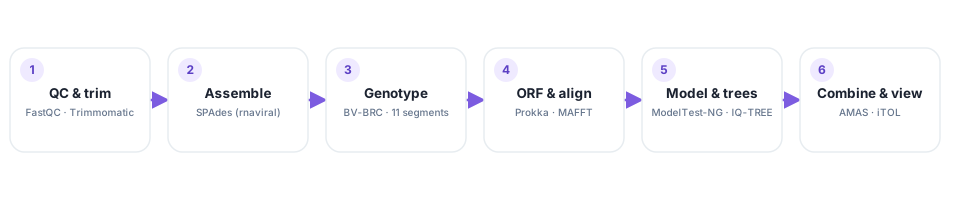
- Raw data QC — FastQC v0.12.1. Assessed read quality (low-quality bases, GC bias, adapter contamination) before any processing.
- Adapter trimming — Trimmomatic v0.38. Trimmed adapters and low-quality regions to produce clean reads for assembly.
- De novo assembly — SPAdes (rnaviral mode). Assembled paired-end reads into contigs using a mode designed for RNA viruses.
- Genotype identification — BV-BRC. Classified each of the 11 gene segments to determine the Rotavirus genotype.
- Reference database assembly. Curated reference segment sequences for meaningful comparative context in the trees.
- ORF identification — Prokka. Pinpointed protein-coding regions across all 11 segments, so trees are built from true coding genes.
- Multiple sequence alignment — MAFFT. Aligned ORFs against reference datasets for position-by-position comparison.
- Alignment quality filtering. Removed poor-quality sequences before modelling, so only high-confidence data entered tree building.
- Model selection — ModelTest-NG. Identified the best-fit nucleotide substitution model per segment via corrected AIC (AICc).
- Segment trees — IQ-TREE 2. Built 11 maximum-likelihood trees (one per segment) with ultrafast bootstrap support.
- Whole-genome concatenation — AMAS. Concatenated all 11 alignments to build a whole-genome tree comparing entire viruses.
- Visualisation — iTOL. Labelled and annotated the trees into publication-ready figures.
Need a research-grade pipeline?
From sequencing QC to publication-ready phylogenetics, we set up and run reliable, reproducible bioinformatics workflows — with results reviewed at every checkpoint.
Book a free scoping call